Local SEO with Ahrefs: A Practical Guide for UK Businesses
Local SEO with Ahrefs: A Practical Guide for UK Businesses
Local search engine optimisation (SEO) helps a business appear when people nearby search for its products or services. For example, a London plumber may want to reach people searching for “emergency plumber in Camden”, while a café in Bristol may want to show up for “coffee shop near me”.
Ahrefs can support many parts of a local SEO campaign, from researching search terms to checking your website and finding link opportunities. It is not a complete local listings platform, however. You’ll also need to manage your Google Business Profile and keep your business information accurate across relevant directories.
What Ahrefs can do for local SEO
Ahrefs is an SEO toolkit that helps you understand search demand, assess websites and investigate links. For local businesses, its tools can help answer practical questions:
- What are people in your area searching for?
- Which local competitors are attracting organic traffic?
- Are there technical issues affecting your website?
- Which local websites might be worth approaching for a link?
- How are your target pages performing in search results?
These insights can inform your local strategy, but they work best alongside accurate business details, helpful local content and a well-maintained Google Business Profile.
Find local keywords with Keywords Explorer
Start by listing the services or products you offer and the areas you serve. Then use Ahrefs’ Keywords Explorer to investigate relevant searches. Add location modifiers such as a town, borough, neighbourhood or postcode area, and consider searches that show local intent, including “near me”, “open now” or “best”.
For example, a London electrician might research phrases such as:
- electrician in Hackney
- emergency electrician East London
- consumer unit replacement London
- electrician near me
Look beyond search volume. A keyword with modest demand may still be valuable if it reflects a clear need and is closely related to a service you provide. Check the search results, too: if they feature local businesses and map results, that is a useful sign of local intent.
Use your research to plan useful service and location pages. Avoid creating near-identical pages for every neighbourhood. Each page should offer information that genuinely helps people in that area, such as relevant services, travel coverage, local project examples or clear details about availability.
Analyse local competitors with Site Explorer
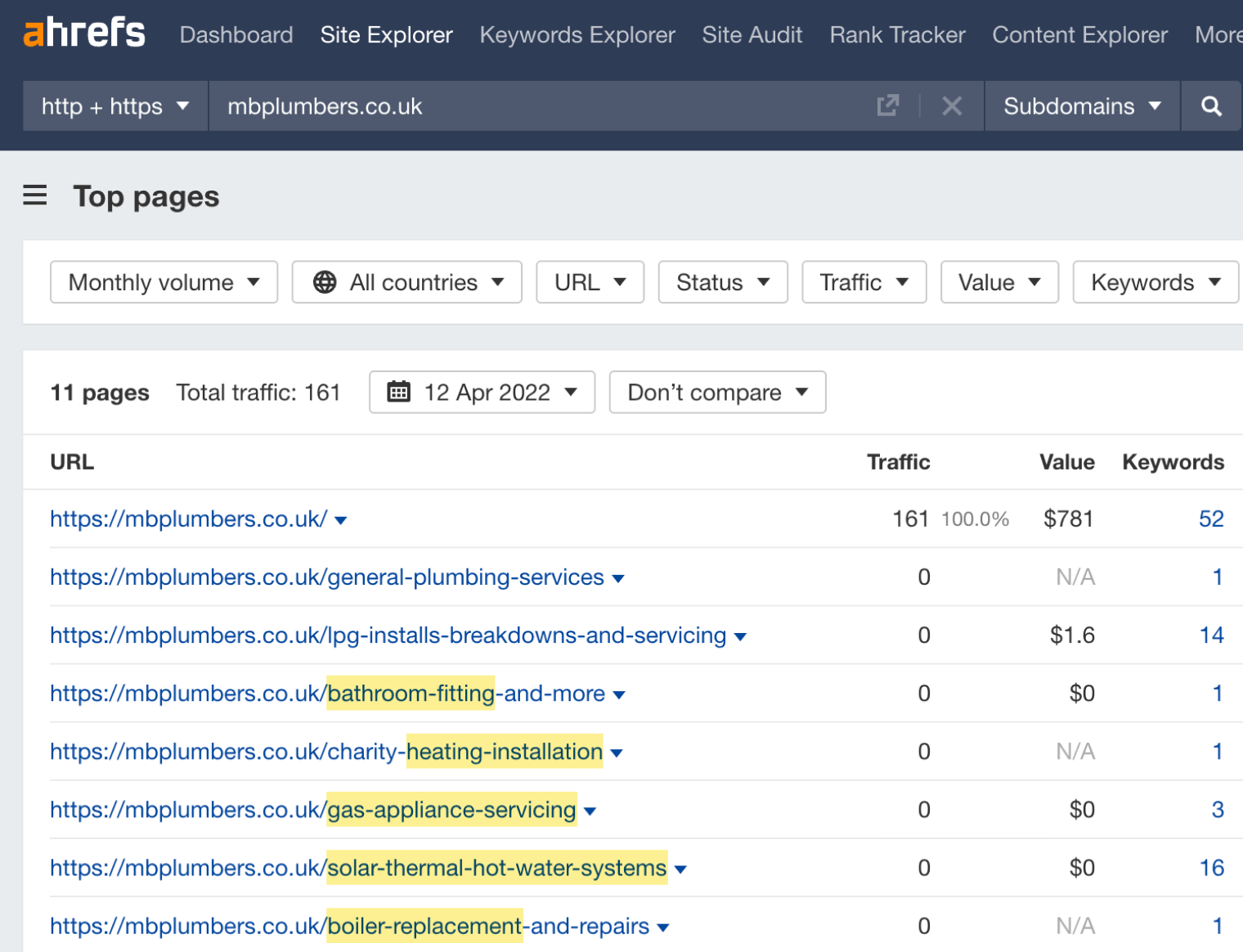
Site Explorer can help you investigate the organic search performance and backlink profiles of competing businesses. Enter a competitor’s website to see which pages attract search traffic and which topics appear to be important to their strategy.
Use this research to spot opportunities, not to copy another business. You might discover that competitors have useful guides, detailed service pages or local case studies that your own website is missing. You can also review their referring websites to identify relevant local publications, trade organisations or community sites that may be worth contacting.
Remember that a competitor’s website data is an estimate, not a complete record of its performance. Treat it as a source of ideas and compare it with what you see in the search results and in your own analytics.
Check your website with Site Audit
A technically sound website makes it easier for search engines and visitors to access your content. Ahrefs’ Site Audit can crawl your site and flag issues that may need attention, such as broken links, redirect problems, missing page titles or slow-loading pages.
For local businesses, check that:
- your key service and location pages can be crawled and indexed;
- each important page has a clear, descriptive title and heading;
- your contact details are easy to find and consistent;
- the website works well on mobile devices;
- internal links connect relevant services, locations and supporting information.
Site Audit findings should be prioritised by their likely impact. Fixing every warning is not necessarily the best use of time; focus first on problems affecting important pages or preventing visitors from completing an action.
Build relevant local links
Links from reputable websites can help search engines understand your business and may introduce you to potential customers. Ahrefs’ Site Explorer and Content Explorer can help you find websites, articles and organisations connected to your industry or area.
Consider opportunities such as local business associations, professional bodies, community groups, event organisers, suppliers and local news sites. A useful contribution, partnership or piece of expert information is generally a stronger reason for a link than a mass outreach email asking for one.
Focus on relevance and quality. A link from a trusted local organisation can be more meaningful than many links from unrelated websites. Avoid buying links or joining schemes designed solely to manipulate rankings.
Track progress over time
Ahrefs’ Rank Tracker can help you monitor selected keywords and review how rankings change. Where available, set the target location to match the market you serve. Search results can vary by location, device and personalisation, so a single ranking should not be treated as the whole picture.
Track a balanced set of terms, including your main services, location-specific phrases and useful informational searches. Review trends over time and compare them with more important business measures, such as enquiries, calls, bookings and sales.
What Ahrefs doesn’t replace
Local SEO depends on more than website rankings. Ahrefs does not replace the work of maintaining your Google Business Profile, responding to reviews or checking your business details across relevant directories. Make sure your name, address and phone number are accurate wherever they appear, and keep your opening hours and service information up to date.
Reviews also matter to potential customers. Encourage genuine feedback from customers in line with Google’s policies, and respond professionally to both positive and negative reviews. Never offer incentives in exchange for reviews or post fake feedback.
A simple local SEO workflow using Ahrefs
- Define your service area: list the towns, boroughs or neighbourhoods you genuinely serve.
- Research search terms: use Keywords Explorer to find relevant local and service-based queries.
- Review your website: run a Site Audit and improve important pages, usability and internal links.
- Study competitors: use Site Explorer to identify content gaps and relevant link opportunities.
- Strengthen local signals: maintain your Google Business Profile, business details and customer reviews.
- Measure results: monitor rankings alongside website visits, calls, enquiries and conversions.
Conclusion
Ahrefs can make local SEO more focused by helping you research keywords, assess competitors, identify website issues and explore link opportunities. The strongest results come when those insights are combined with useful local pages, accurate business listings and a positive customer experience.
Use Ahrefs as part of a broader local SEO process, rather than expecting any single tool to deliver rankings on its own. Start with the searches your customers use, make your website genuinely helpful and measure success by the enquiries and customers your visibility brings in.
Top 6 FAQs About Using Ahrefs for Local SEO
- Can I use Ahref for free?
- Is Ahrefs a SEO tool?
- How is local SEO different from SEO?
- Is local SEO paid?
- How can I do local SEO?
- How do I use Ahrefs for local SEO?
Can I use Ahref for free?
Yes, you can use some Ahrefs tools for free. Ahrefs offers a selection of free SEO tools, and Ahrefs Webmaster Tools provides limited access to site audits and backlink data for websites you own and verify. These can help with local SEO basics, but features such as more extensive keyword research and rank tracking may require a paid plan.
Is Ahrefs a SEO tool?
Yes, Ahrefs is an SEO toolset that helps businesses research keywords, analyse competitors’ websites and backlinks, audit technical issues and track search rankings. It can support local SEO by uncovering location-specific search terms and opportunities, but it does not replace managing your Google Business Profile, reviews or local business listings.
How is local SEO different from SEO?
SEO aims to improve a website’s visibility in search results more broadly, while local SEO focuses on reaching people searching for businesses, products or services in a specific area. It places greater emphasis on location-based searches, Google Business Profile, local listings, customer reviews and locally relevant pages. Tools such as Ahrefs can help with keyword research, competitor analysis and website checks for both, but local SEO also depends on accurate business details and strong local signals.
Is local SEO paid?
Local SEO isn’t paid advertising: it focuses on improving your visibility in organic search results and Google Maps. Creating a Google Business Profile is free, although you may choose to pay for SEO tools such as Ahrefs or hire a specialist to help with research, content and optimisation. You can also run paid search ads, but these are separate from local SEO and stop appearing when your advertising budget runs out.
How can I do local SEO?
To do local SEO, make sure your website clearly explains what your business offers and where you serve, with useful service and location pages rather than repetitive pages for every area. Keep your Google Business Profile accurate and up to date, maintain consistent business details across relevant directories, and encourage genuine customer reviews. Use Ahrefs to research local search terms, check your website for technical issues, review competitors and find relevant local link opportunities. Track rankings alongside calls, enquiries and sales so you can see whether your work is attracting the right customers.
How do I use Ahrefs for local SEO?
Use Ahrefs to research location-specific keywords in Keywords Explorer, analyse local competitors’ pages and backlinks in Site Explorer, and run Site Audit to find technical issues on your website. You can also use Rank Tracker to monitor important local search terms and discover relevant local websites that may offer link opportunities. Pair these insights with an up-to-date Google Business Profile, accurate business details and useful pages for the areas you serve.
Leave a Reply