local organic seo

Local Organic SEO: A Practical Guide to Growing Your Local Visibility

Local Organic SEO: How to Improve Your Visibility in Local Search

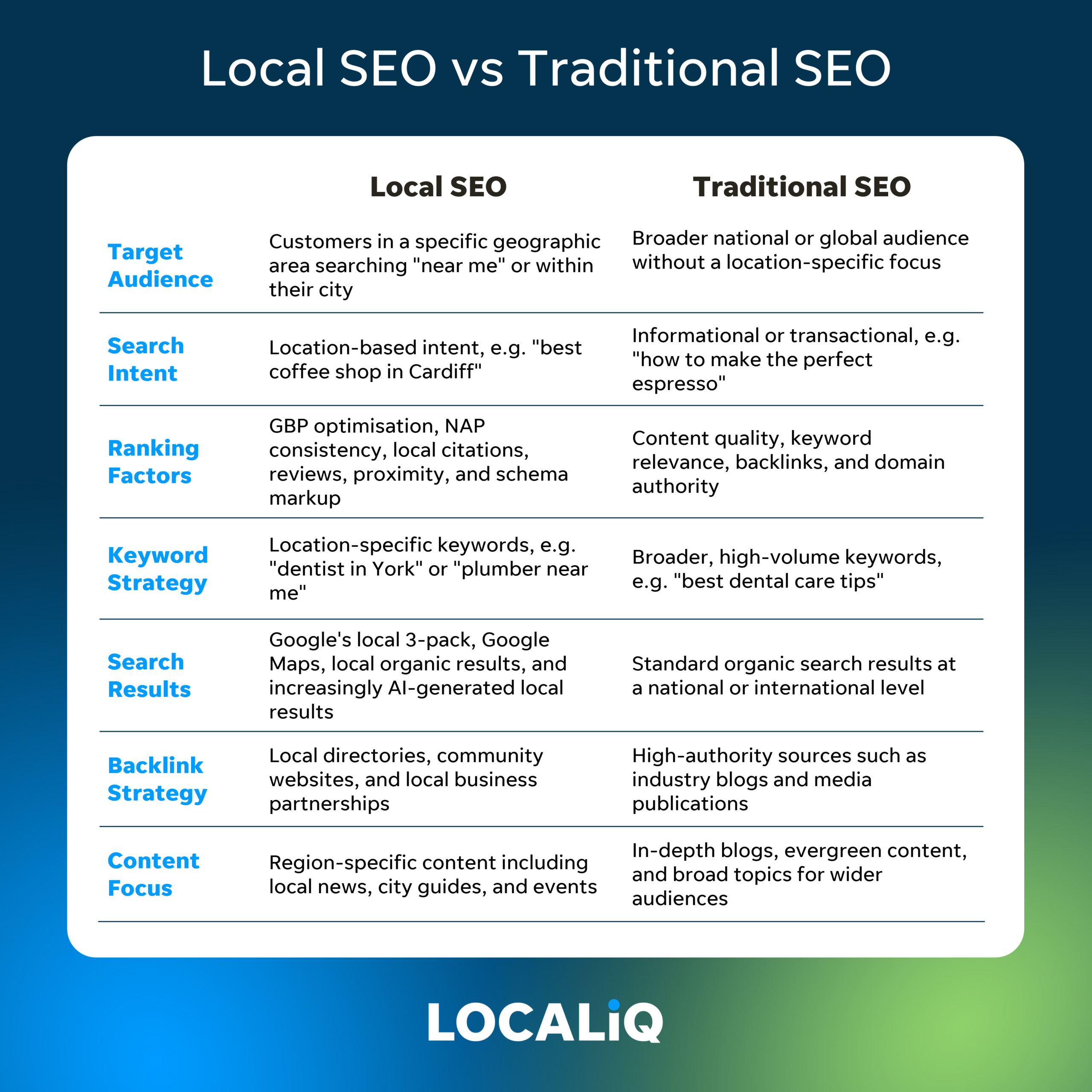
When someone searches for a service “near me” or adds a town or postcode to their query, they are often looking for a business they can contact or visit soon. Local organic SEO helps your business appear in the unpaid search results for these location-based searches.

Whether you run a shop, restaurant, professional practice or service-area business, a well-planned local SEO strategy can help nearby customers discover your website. Here’s what local organic SEO involves and how to strengthen your visibility.

What is local organic SEO?

Local organic SEO is the process of improving your website’s visibility in unpaid search results for searches with local intent. Examples include “accountant in Bristol”, “plumber near me” and “best café in Camden”.

It is useful to distinguish between two types of local search results:

  • Local organic results are standard website listings that appear because search engines consider them relevant and useful for a local query.
  • Local pack results are map-based listings, usually featuring businesses and their locations. These are influenced by factors such as relevance, distance and prominence.

Both can contribute to local visibility, but they are not the same. A strong local strategy should support your website’s organic performance as well as your presence in relevant business listings.

Why local organic SEO matters

Local searches often indicate that someone has a specific need and is considering nearby options. Appearing prominently can help potential customers find your services, learn about your business and take the next step.

Unlike paid advertising, organic search traffic does not depend on paying for each click. However, SEO takes time and ongoing work, and rankings cannot be guaranteed. The aim is to build a useful, credible online presence that is relevant to both search engines and people in your area.

Key elements of a local organic SEO strategy

Research local search terms

Start by finding out how customers describe your services and the areas they search for. Consider service names, locations and phrases that show clear intent. For example, a searcher may use “roof repairs in Leeds” rather than simply “roofer”.

Use keyword research tools, search suggestions and conversations with customers to build a realistic list of topics. Avoid creating pages for every possible variation of a search term; focus on phrases that reflect genuine services and locations you can serve.

Create useful, location-relevant pages

Your website should clearly explain what you offer, who you serve and where you operate. If you serve several distinct locations, consider creating dedicated location pages where there is enough unique information to make each one valuable.

A good location page should provide helpful details, such as:

  • The services available in that area
  • Relevant local experience or examples of work
  • Opening hours, contact details or service coverage
  • Directions or information about visiting your premises, where relevant
  • Answers to questions customers in that area are likely to have

Avoid publishing near-identical pages with only the place name changed. Thin or repetitive content is unlikely to be useful to visitors and may weaken the quality of your site.

Optimise your website’s on-page content

Use clear page titles, headings and descriptions that accurately summarise each page. Mention your location naturally where it helps visitors understand your service area, but do not force place names into every sentence.

Make sure each important service has a relevant page and that your navigation makes it easy for visitors to find information. Internal links between related service and location pages can help people—and search engines—understand how your content is connected.

Keep your business information consistent

Ensure your business name, address and phone number are accurate wherever they appear online. Consistency across your website, business listings and relevant directories helps customers verify your details.

If your business serves customers at an address, show the correct address and visiting information. If you travel to customers instead, describe your service areas accurately and follow the rules of the platforms where your business is listed.

Improve your business profile and local listings

Claim and maintain your Google Business Profile and other relevant profiles. Add accurate categories, services, opening hours, contact details and photographs. Keep information updated when anything changes.

Reviews can also help people assess whether your business is right for them. Encourage genuine feedback from customers, respond professionally and do not buy or fabricate reviews. Review management supports trust and reputation, though it does not guarantee higher rankings.

Build local relevance and authority

Links from reputable local organisations, suppliers, business groups, charities or community publications can help people discover your business and may contribute to your site’s authority. Focus on genuine relationships and useful local involvement rather than buying links or pursuing low-quality directories.

Local mentions do not always need to include a link to be useful for brand awareness, but a relevant link can make it easier for readers to reach your website.

Make your website fast and easy to use on mobile

Many people search for local businesses on their phones, sometimes while travelling. Your website should load reliably, display clearly on smaller screens and make key actions—such as calling, booking or finding directions—easy to complete.

Check that contact forms work, phone numbers are tappable and important information is not hidden behind confusing menus. A smooth experience helps visitors use your site and supports your wider digital performance.

How to measure local organic SEO

Rankings are only one part of the picture. Review a range of measures to understand whether your work is reaching the right audience and supporting business goals, including:

  • Organic visits to service and location pages
  • Search queries and impressions in Google Search Console
  • Calls, enquiries, bookings or purchases from organic visitors
  • Engagement with your business profiles, such as website clicks or direction requests
  • Visibility across relevant local search terms and locations

Use analytics and tracking tools where appropriate, and make sure they are configured in line with privacy and data protection requirements. Look at trends over time rather than relying on a single ranking or short-term change.

Common local SEO mistakes to avoid

  • Creating duplicate location pages with little useful information
  • Adding location keywords unnaturally to page titles or body copy
  • Using inaccurate addresses or claiming locations where you do not operate
  • Ignoring outdated business details across listings
  • Buying links or reviews
  • Focusing only on rankings instead of enquiries and customer experience

Build a stronger local presence

Local organic SEO is an ongoing process. Start with accurate business information, a technically sound website and clear pages that answer local customers’ questions. Then build your reputation through useful content, genuine customer feedback and meaningful links from relevant sources.

With consistent effort, your business can become easier to find in local searches and better equipped to turn online visibility into real enquiries and visits.


5 Essential Tips to Boost Your Local Organic SEO

  1. Keep your Google Business Profile accurate and up to date.
  2. Use local keywords naturally on your website.
  3. Create a separate page for each area you serve.
  4. Ask happy customers for honest reviews.
  5. Earn links from trusted local organisations.

Keep your Google Business Profile accurate and up to date.

Keep your Google Business Profile accurate and up to date so local customers can find reliable information about your business. Check that your name, address, phone number, opening hours, website link and services are correct, and update them promptly whenever anything changes. Add recent photos and respond professionally to customer reviews to give people a clearer picture of what you offer and help them feel confident choosing your business.

Use local keywords naturally on your website.

Use local keywords naturally throughout your website to help search engines and visitors understand where you operate and what you offer. Include relevant place names alongside your services in page titles, headings and useful body copy—for example, “family solicitor in York”—but only where they fit the context. Avoid repeating keywords unnaturally or creating pages for locations you do not serve; clear, genuinely helpful content is more valuable than keyword stuffing.

Create a separate page for each area you serve.

Create a separate page for each area you serve when you can provide genuinely useful, location-specific information. Explain which services are available there, describe relevant local experience and include clear contact details or service-area information. Avoid simply duplicating one page and swapping in different place names: each page should offer distinct value to local visitors and accurately reflect the areas your business serves.

Ask happy customers for honest reviews.

Ask happy customers to leave an honest review about their experience. Genuine feedback can help people in your area feel more confident choosing your business and gives you useful insight into what you do well. Make the request politely, make it easy to find your review page, and never offer incentives for positive reviews or ask customers to say anything untrue. Respond to feedback professionally, thanking customers for positive comments and addressing concerns constructively.

Earn links from trusted local organisations by building genuine relationships in your community. Sponsoring a local event, partnering with a charity, joining a business association or contributing useful expertise to a local publication may give people a good reason to link to your website. Relevant links can help local customers discover your business and strengthen your online credibility. Focus on worthwhile partnerships and useful contributions rather than buying links or taking part in schemes designed solely to manipulate search rankings.
local seo ahrefs

Local SEO with Ahrefs: A Practical Guide for UK Businesses

Local SEO with Ahrefs: A Practical Guide for UK Businesses

Local search engine optimisation (SEO) helps a business appear when people nearby search for its products or services. For example, a London plumber may want to reach people searching for “emergency plumber in Camden”, while a café in Bristol may want to show up for “coffee shop near me”.

Ahrefs can support many parts of a local SEO campaign, from researching search terms to checking your website and finding link opportunities. It is not a complete local listings platform, however. You’ll also need to manage your Google Business Profile and keep your business information accurate across relevant directories.

What Ahrefs can do for local SEO

Ahrefs is an SEO toolkit that helps you understand search demand, assess websites and investigate links. For local businesses, its tools can help answer practical questions:

  • What are people in your area searching for?
  • Which local competitors are attracting organic traffic?
  • Are there technical issues affecting your website?
  • Which local websites might be worth approaching for a link?
  • How are your target pages performing in search results?

These insights can inform your local strategy, but they work best alongside accurate business details, helpful local content and a well-maintained Google Business Profile.

Find local keywords with Keywords Explorer

Start by listing the services or products you offer and the areas you serve. Then use Ahrefs’ Keywords Explorer to investigate relevant searches. Add location modifiers such as a town, borough, neighbourhood or postcode area, and consider searches that show local intent, including “near me”, “open now” or “best”.

For example, a London electrician might research phrases such as:

  • electrician in Hackney
  • emergency electrician East London
  • consumer unit replacement London
  • electrician near me

Look beyond search volume. A keyword with modest demand may still be valuable if it reflects a clear need and is closely related to a service you provide. Check the search results, too: if they feature local businesses and map results, that is a useful sign of local intent.

Use your research to plan useful service and location pages. Avoid creating near-identical pages for every neighbourhood. Each page should offer information that genuinely helps people in that area, such as relevant services, travel coverage, local project examples or clear details about availability.

Analyse local competitors with Site Explorer

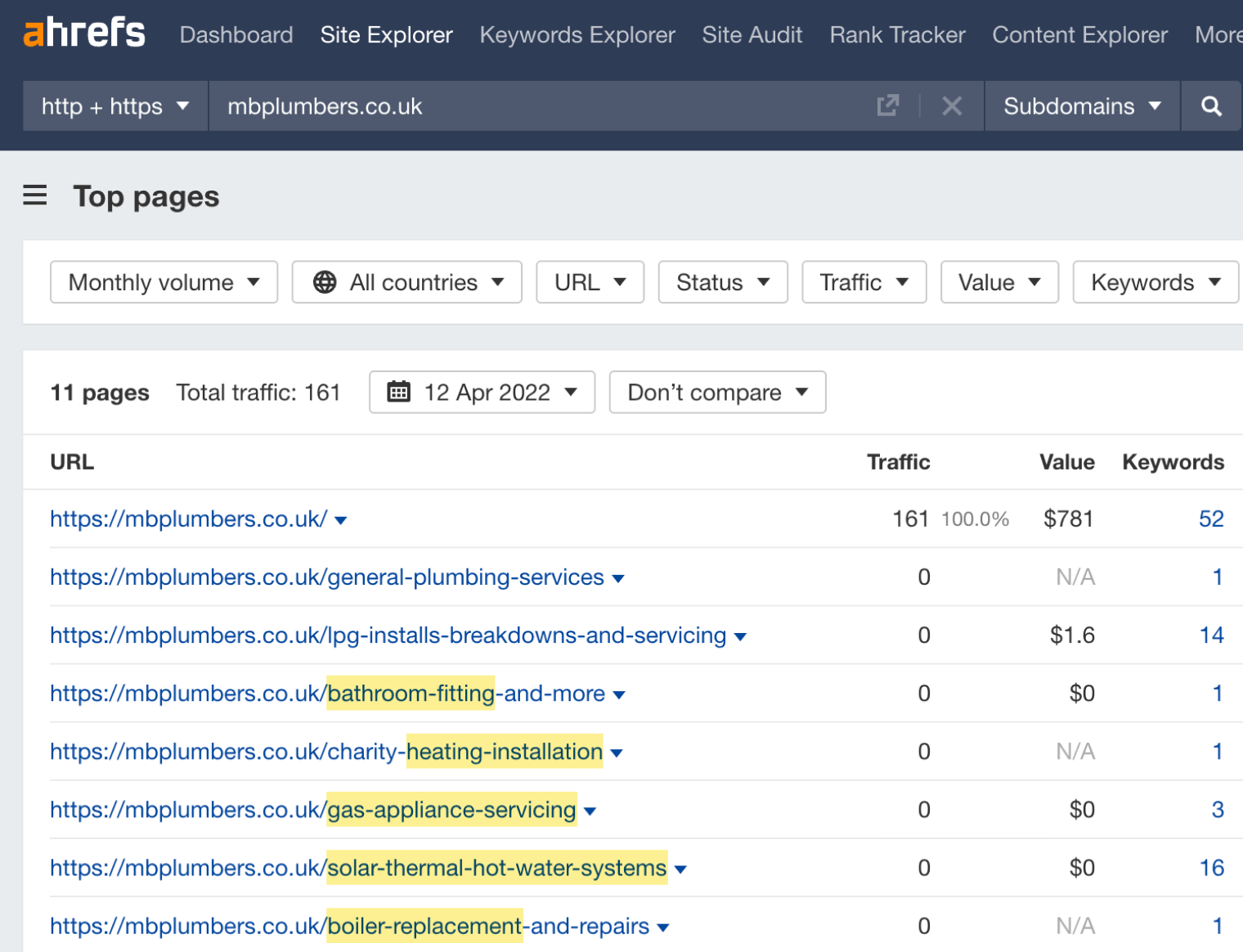
Site Explorer can help you investigate the organic search performance and backlink profiles of competing businesses. Enter a competitor’s website to see which pages attract search traffic and which topics appear to be important to their strategy.

Use this research to spot opportunities, not to copy another business. You might discover that competitors have useful guides, detailed service pages or local case studies that your own website is missing. You can also review their referring websites to identify relevant local publications, trade organisations or community sites that may be worth contacting.

Remember that a competitor’s website data is an estimate, not a complete record of its performance. Treat it as a source of ideas and compare it with what you see in the search results and in your own analytics.

Check your website with Site Audit

A technically sound website makes it easier for search engines and visitors to access your content. Ahrefs’ Site Audit can crawl your site and flag issues that may need attention, such as broken links, redirect problems, missing page titles or slow-loading pages.

For local businesses, check that:

  • your key service and location pages can be crawled and indexed;
  • each important page has a clear, descriptive title and heading;
  • your contact details are easy to find and consistent;
  • the website works well on mobile devices;
  • internal links connect relevant services, locations and supporting information.

Site Audit findings should be prioritised by their likely impact. Fixing every warning is not necessarily the best use of time; focus first on problems affecting important pages or preventing visitors from completing an action.

Build relevant local links

Links from reputable websites can help search engines understand your business and may introduce you to potential customers. Ahrefs’ Site Explorer and Content Explorer can help you find websites, articles and organisations connected to your industry or area.

Consider opportunities such as local business associations, professional bodies, community groups, event organisers, suppliers and local news sites. A useful contribution, partnership or piece of expert information is generally a stronger reason for a link than a mass outreach email asking for one.

Focus on relevance and quality. A link from a trusted local organisation can be more meaningful than many links from unrelated websites. Avoid buying links or joining schemes designed solely to manipulate rankings.

Track progress over time

Ahrefs’ Rank Tracker can help you monitor selected keywords and review how rankings change. Where available, set the target location to match the market you serve. Search results can vary by location, device and personalisation, so a single ranking should not be treated as the whole picture.

Track a balanced set of terms, including your main services, location-specific phrases and useful informational searches. Review trends over time and compare them with more important business measures, such as enquiries, calls, bookings and sales.

What Ahrefs doesn’t replace

Local SEO depends on more than website rankings. Ahrefs does not replace the work of maintaining your Google Business Profile, responding to reviews or checking your business details across relevant directories. Make sure your name, address and phone number are accurate wherever they appear, and keep your opening hours and service information up to date.

Reviews also matter to potential customers. Encourage genuine feedback from customers in line with Google’s policies, and respond professionally to both positive and negative reviews. Never offer incentives in exchange for reviews or post fake feedback.

A simple local SEO workflow using Ahrefs

  1. Define your service area: list the towns, boroughs or neighbourhoods you genuinely serve.
  2. Research search terms: use Keywords Explorer to find relevant local and service-based queries.
  3. Review your website: run a Site Audit and improve important pages, usability and internal links.
  4. Study competitors: use Site Explorer to identify content gaps and relevant link opportunities.
  5. Strengthen local signals: maintain your Google Business Profile, business details and customer reviews.
  6. Measure results: monitor rankings alongside website visits, calls, enquiries and conversions.

Conclusion

Ahrefs can make local SEO more focused by helping you research keywords, assess competitors, identify website issues and explore link opportunities. The strongest results come when those insights are combined with useful local pages, accurate business listings and a positive customer experience.

Use Ahrefs as part of a broader local SEO process, rather than expecting any single tool to deliver rankings on its own. Start with the searches your customers use, make your website genuinely helpful and measure success by the enquiries and customers your visibility brings in.


Top 6 FAQs About Using Ahrefs for Local SEO

  1. Can I use Ahref for free?
  2. Is Ahrefs a SEO tool?
  3. How is local SEO different from SEO?
  4. Is local SEO paid?
  5. How can I do local SEO?
  6. How do I use Ahrefs for local SEO?

Can I use Ahref for free?

Yes, you can use some Ahrefs tools for free. Ahrefs offers a selection of free SEO tools, and Ahrefs Webmaster Tools provides limited access to site audits and backlink data for websites you own and verify. These can help with local SEO basics, but features such as more extensive keyword research and rank tracking may require a paid plan.

Is Ahrefs a SEO tool?

Yes, Ahrefs is an SEO toolset that helps businesses research keywords, analyse competitors’ websites and backlinks, audit technical issues and track search rankings. It can support local SEO by uncovering location-specific search terms and opportunities, but it does not replace managing your Google Business Profile, reviews or local business listings.

How is local SEO different from SEO?

SEO aims to improve a website’s visibility in search results more broadly, while local SEO focuses on reaching people searching for businesses, products or services in a specific area. It places greater emphasis on location-based searches, Google Business Profile, local listings, customer reviews and locally relevant pages. Tools such as Ahrefs can help with keyword research, competitor analysis and website checks for both, but local SEO also depends on accurate business details and strong local signals.

Is local SEO paid?

Local SEO isn’t paid advertising: it focuses on improving your visibility in organic search results and Google Maps. Creating a Google Business Profile is free, although you may choose to pay for SEO tools such as Ahrefs or hire a specialist to help with research, content and optimisation. You can also run paid search ads, but these are separate from local SEO and stop appearing when your advertising budget runs out.

How can I do local SEO?

To do local SEO, make sure your website clearly explains what your business offers and where you serve, with useful service and location pages rather than repetitive pages for every area. Keep your Google Business Profile accurate and up to date, maintain consistent business details across relevant directories, and encourage genuine customer reviews. Use Ahrefs to research local search terms, check your website for technical issues, review competitors and find relevant local link opportunities. Track rankings alongside calls, enquiries and sales so you can see whether your work is attracting the right customers.

How do I use Ahrefs for local SEO?

Use Ahrefs to research location-specific keywords in Keywords Explorer, analyse local competitors’ pages and backlinks in Site Explorer, and run Site Audit to find technical issues on your website. You can also use Rank Tracker to monitor important local search terms and discover relevant local websites that may offer link opportunities. Pair these insights with an up-to-date Google Business Profile, accurate business details and useful pages for the areas you serve.