local seo 101

Local SEO 101: A Beginner’s Guide to Getting Found Nearby

Local SEO 101: A Beginner’s Guide to Getting Found Nearby

When someone searches for a nearby service, such as “plumber in Bristol” or “coffee shop near me”, search engines try to show businesses that are relevant to the search and the person’s location. Local search engine optimisation (local SEO) helps your business appear in these results.

Whether you run a shop, restaurant, consultancy or service-area business, local SEO can help potential customers discover you online and decide whether to get in touch. Here’s how to get started.

What is local SEO?

Local SEO is the work of improving your business’s visibility in search results for location-based searches. These results can include ordinary web listings, map results and Google’s local results, which often display a map alongside nearby businesses.

Search engines generally consider three broad factors when deciding which local businesses to show:

  • Relevance: How closely your business matches what the person is looking for.
  • Distance: How near the business is to the searcher or the location included in the search.
  • Prominence: How established and well-regarded the business appears online.

You can influence relevance and prominence through accurate information, useful website content, reviews and mentions from other trusted websites. Distance is largely determined by the searcher’s location, so it cannot be optimised in the same way.

Set up and improve your Google Business Profile

A Google Business Profile can help eligible businesses appear in Google Search and Maps. Claim or create your profile, then make sure its details are accurate and complete.

  • Use your real-world business name, rather than adding extra keywords or locations.
  • Choose the most appropriate primary category and any relevant additional categories.
  • Add your correct address, phone number, website and opening hours.
  • Describe your services clearly and add helpful photos.
  • Keep holiday hours and other changes up to date.

If you visit customers rather than serving them at your premises, set up your service area appropriately and follow Google’s eligibility and address-display rules. A profile is not a substitute for a useful website, but it can be an important part of your local presence.

Keep your business details consistent

Your business name, address and phone number are often referred to as NAP. Make sure these details are correct on your website, Google Business Profile, social media pages and reputable business directories.

Consistency helps customers contact you and makes your business information easier for search engines to interpret. If your address or phone number changes, update important listings rather than allowing old details to linger.

Optimise your website for local searches

Your website should make it obvious what you offer, where you operate and how people can contact you. Start with the essentials:

  • Include your service and location naturally in relevant page titles, headings and copy.
  • Give each important service a clear page with useful, original information.
  • Display your contact details prominently, especially on mobile devices.
  • Add an embedded map or directions where it helps visitors.
  • Make sure your site loads quickly, works well on phones and uses HTTPS.

Avoid creating lots of near-identical pages that only swap one town name for another. Pages should offer genuinely useful information for people in each area, not just repeat keywords.

Find the local keywords customers use

Think about the words people might use when looking for your products or services. These could include a service, a product, a neighbourhood, a town or phrases such as “near me”. Use these ideas to guide your website content, but write naturally for people rather than trying to fit every variation into a page.

Helpful sources for keyword ideas include customer questions, search suggestions, your website’s search data and conversations with your sales or customer service team. A useful page answers a real question or helps someone make a decision.

Earn and respond to customer reviews

Reviews can help prospective customers understand what it is like to do business with you. Invite customers to leave honest feedback after a genuine interaction, and make it easy for them to do so. Do not offer rewards for reviews or pressure customers to leave only positive feedback.

Respond politely to both positive and negative reviews. Thank customers for their comments, and address concerns constructively without sharing private information. A thoughtful response can demonstrate that you take feedback seriously.

Build local links and mentions

Links and mentions from relevant, trusted organisations can help people discover your business and contribute to your online reputation. Consider legitimate opportunities such as local business associations, community organisations, industry partners, event sponsorships or local publications.

Focus on relationships and useful contributions rather than buying links or joining schemes designed to manipulate rankings. Low-quality, unrelated links are unlikely to provide lasting value.

Measure what matters

Local SEO takes time, so track progress rather than judging it by a single search or ranking. Useful measures include:

  • Calls, enquiries, bookings or purchases from local customers.
  • Visits to key service and location pages.
  • Clicks for directions or visits to your website from your business profile.
  • Search impressions and clicks for relevant local queries.
  • The number, quality and themes of customer reviews.

Use tools such as Google Search Console, website analytics and the reporting available in your business profile. Rankings can vary depending on the searcher’s location, device and search terms, so combine visibility data with real business outcomes.

Common local SEO mistakes to avoid

  • Using an incorrect business address or creating profiles for locations where you are not eligible.
  • Adding keywords to your business name when they are not part of its real-world name.
  • Publishing thin, duplicate pages for multiple locations.
  • Ignoring reviews or leaving outdated contact details online.
  • Expecting a quick ranking boost or guaranteed top placement.

Getting started with local SEO

Begin with the basics: claim your business profile, check your contact details, improve your key website pages and create a simple process for requesting honest customer reviews. Then build useful local relationships and review your results regularly.

Local SEO is an ongoing effort, not a one-off fix. By providing accurate information and a helpful experience for both searchers and customers, you can strengthen your chances of being found when people nearby need what your business offers.


Local SEO 101: 6 Essential Tips to Help Your Business Get Found

  1. Create and verify your Google Business Profile.
  2. Keep your name, address and phone number consistent everywhere.
  3. Choose accurate business categories and add your opening hours.
  4. Use local keywords naturally on your website.
  5. Ask happy customers for honest reviews and reply to them.
  6. Make sure your website works well on mobile.

Create and verify your Google Business Profile.

Create and verify your Google Business Profile to help your business appear in local Google Search and Maps results. Enter accurate, up-to-date details, including your business name, address or service area, phone number, opening hours and website, then choose the categories that best describe what you do. Verification confirms that you’re authorised to manage the profile. Once it’s live, keep the information current and add useful photos so nearby customers can find and learn about your business.

Keep your name, address and phone number consistent everywhere.

Keep your business name, address and phone number (NAP) accurate and consistent wherever they appear online, including your website, Google Business Profile, social media pages and reputable directories. Matching details help customers contact you with confidence and make it easier for search engines to recognise that each listing refers to the same business. If your details change, update your key listings promptly to avoid confusion.

Choose accurate business categories and add your opening hours.

Choose the most accurate categories for your business so search engines and potential customers can understand what you offer. Select a primary category that best describes your main service, and add relevant secondary categories where appropriate. Keep your opening hours up to date, including bank holidays and temporary changes, so customers know when they can visit or contact you.

Use local keywords naturally on your website.

Use local keywords naturally throughout your website to help search engines and potential customers understand where you operate and what you offer. Include relevant place names alongside your services in page titles, headings and copy—for example, “family solicitor in Leeds”—where they fit the content. Avoid forcing in repeated keywords or listing multiple locations unnaturally; clear, useful writing is more effective and creates a better experience for visitors.

Ask happy customers for honest reviews and reply to them.

Ask happy customers to leave an honest review after they’ve used your service, making it easy for them to share their experience without offering incentives or pressuring them. Reviews can help local customers decide which business to choose, while regular, thoughtful replies show that you value feedback. Thank customers for positive comments, and respond calmly and constructively to concerns, taking care not to share private information.

Make sure your website works well on mobile.

Make sure your website works well on mobile, as many people search for local businesses while they’re out and about. Pages should load quickly, be easy to read without zooming and have simple navigation. Make essential details—such as your phone number, address, opening hours and booking options—easy to find and use on a small screen. A smooth mobile experience helps potential customers take the next step, whether that’s calling, getting directions or making an appointment.
local seo news

Local SEO News: The Latest Trends and Updates for UK Businesses

Local SEO News: The Trends UK Businesses Should Be Watching

Local search continues to change as search engines refine how they show nearby businesses and people use new tools to find services. For UK businesses, keeping up with local SEO news is not just about following algorithm updates. It is about understanding how customers search, making business information easy to trust and ensuring that your online presence reflects what you offer in the real world.

Google Business Profile remains central

A well-maintained Google Business Profile is still an important part of local visibility. Accurate opening hours, contact details, categories and service information help potential customers decide whether to get in touch. Businesses should check their profiles regularly, especially around bank holidays, seasonal changes or any change of address or phone number.

Recent local SEO conversations also highlight the value of useful, up-to-date profile content. Add relevant photos, respond to questions and keep services and business details current. These actions can make a profile more helpful to customers, although no single update can guarantee a higher ranking.

Reviews influence trust as well as visibility

Customer reviews remain a prominent feature of local search results. They can help people compare businesses before making a call, booking an appointment or visiting a shop. The best approach is to invite genuine feedback from customers and respond professionally to both positive and negative reviews.

Avoid buying reviews or offering rewards in exchange for favourable ratings. These practices can breach platform policies and damage trust. A steady flow of honest feedback is more valuable than a sudden collection of suspiciously similar reviews.

AI is changing how people discover local businesses

AI-powered search features are changing the way some users ask questions and explore options. Instead of entering a short phrase such as “plumber in Leeds”, a customer might ask for a recommendation based on location, availability or a particular type of job. Search experiences are evolving, so businesses should make their services, areas covered and expertise clear across their website and business profiles.

There is no special shortcut that guarantees inclusion in AI-generated results. A practical foundation remains essential: accurate business details, clear service pages, useful information and a trustworthy reputation across the web.

Local content needs to be genuinely useful

Creating a separate page for every nearby town may seem like an easy way to target more locations, but thin or repetitive pages offer little value. Strong local landing pages explain what a business does in that area, which customers it serves and what makes its service relevant. Include accurate local details rather than simply repeating place names.

For example, a tradesperson could describe the types of properties they work on, the services available locally and the areas they can realistically reach. A retailer might provide practical information about visiting its premises, including parking, public transport and accessibility.

Consistency and technical basics still matter

Business name, address and phone number information should be consistent wherever customers may find it. Check important directories and social profiles for outdated details, particularly after moving premises or changing your trading name. On your website, make sure contact information is easy to find and that pages work well on mobile devices.

Structured data can help search engines interpret information about a business, but it should accurately reflect visible content on the page. It is not a substitute for a useful website or a complete business profile.

What local businesses should do next

  • Review your Google Business Profile and correct any outdated information.
  • Make it easy for satisfied customers to leave honest reviews, and respond courteously to feedback.
  • Improve location and service pages with specific, helpful information.
  • Check your business details across key directories and social platforms.
  • Monitor calls, enquiries, bookings and visits—not rankings alone.

Keep up with local SEO news, but focus on customers

Local SEO news can help businesses spot changes in search features and customer behaviour, but reacting to every rumour can waste time. Focus first on the fundamentals: accurate information, useful local content, a strong customer experience and a credible reputation. These are the foundations that help people find, evaluate and choose a local business, whatever changes come next in search.


Essential FAQs on Local SEO News: Insights for UK Businesses in 2026

  1. What is local SEO news?
  2. Why is local SEO important for UK businesses?
  3. How often does Google update local search results?
  4. What local SEO changes should businesses watch for in 2026?
  5. How do Google Business Profile updates affect local rankings?
  6. Do customer reviews influence local SEO rankings?
  7. How is AI changing local search results?
  8. What are the best ways to keep up with local SEO news?
  9. How can a business measure the impact of local SEO updates?

What is local SEO news?

Local SEO news covers updates, trends and practical advice that affect how businesses appear in location-based search results. It may include changes to Google Business Profile, local ranking factors, customer reviews, map listings and search behaviour. Following local SEO news can help businesses keep their online information accurate and adapt their marketing to make it easier for nearby customers to find them.

Why is local SEO important for UK businesses?

Local SEO is important for UK businesses because it helps them reach people searching for nearby products and services, whether they are looking for a shop, tradesperson or professional service. By keeping business details accurate, building a strong local reputation and creating useful location-focused content, businesses can make it easier for potential customers to discover them, compare their options and get in touch. This is particularly valuable for businesses that serve specific towns, cities or neighbourhoods, where appearing in relevant local search results can support more calls, visits and enquiries.

How often does Google update local search results?

Google does not update local search results to a fixed public schedule. Rankings and listings can change continuously as Google processes new information, such as updates to business profiles, customer reviews and website content, while also considering factors including relevance, distance and prominence. Wider changes to Google’s systems may affect results too, so brief fluctuations are normal; businesses should keep their details accurate and monitor performance over time rather than expecting daily changes to follow a predictable timetable.

What local SEO changes should businesses watch for in 2026?

As businesses look towards 2026, several local SEO changes could significantly impact their strategies. One major area to watch is the increasing integration of artificial intelligence in search algorithms, which may enhance personalised search results and alter how local businesses appear to potential customers. Additionally, voice search is expected to continue its rise in popularity, necessitating optimised content for natural language queries. The importance of zero-click searches might also grow, with more users finding answers directly on the search results page without visiting a website. Furthermore, businesses should prepare for enhanced mobile-first indexing as mobile usage continues to dominate online searches. Staying informed about these trends and adapting strategies accordingly will be crucial for maintaining visibility in local search results.

How do Google Business Profile updates affect local rankings?

Google Business Profile updates can influence local visibility by helping Google and potential customers understand your business more clearly. Keeping your address, opening hours, contact details, categories and services accurate may help your profile appear for relevant local searches and gives customers reliable information when they find you. However, updates alone do not guarantee higher rankings: local results are also shaped by factors such as relevance, distance and prominence, as well as your website and reputation. Make changes promptly when details change, and keep your profile complete and helpful rather than adding keywords where they do not belong.

Do customer reviews influence local SEO rankings?

Yes, customer reviews can influence local SEO, but they are only one of several factors search engines consider. Review signals such as overall ratings, the number of reviews and how recently they were posted may help search engines assess a business’s prominence and relevance. Reviews also build trust and can encourage more people to choose your business, which may lead to additional enquiries and visits. Encourage genuine feedback, respond professionally and never buy reviews or offer rewards for positive ratings.

How is AI changing local search results?

AI is changing local search by helping people find businesses through more conversational, detailed queries and by presenting information in AI-generated summaries and recommendations. Rather than searching only for “restaurant near me”, someone might ask for a family-friendly café open late with vegan options. Search engines may draw on business profiles, websites, reviews and other online information to shape their responses. Local businesses can prepare by keeping their details accurate and consistent, clearly describing their services and areas covered, and building a helpful, trustworthy website and genuine customer reviews. These steps support visibility, although no tactic can guarantee inclusion in AI-generated results.

What are the best ways to keep up with local SEO news?

The best way to keep up with local SEO news is to follow reliable sources such as Google Search Central and the Google Business Profile Help community, alongside trusted SEO publications and industry experts. Join relevant professional groups or webinars, and set aside time each week to review important updates. Focus on confirmed changes rather than rumours, and test how developments affect your own website and business profile before making major changes.

How can a business measure the impact of local SEO updates?

A business can measure the impact of local SEO updates by recording key performance indicators before and after each change, then reviewing them over a consistent period. Track local search visibility and Google Business Profile activity alongside meaningful outcomes such as website visits, phone calls, direction requests, bookings and enquiries. Use tools such as Google Search Console, Google Analytics and Business Profile performance data, and compare like-for-like periods to account for seasonality. Keep notes of updates and other marketing activity, as this helps show which changes may have contributed to results. Ranking improvements can be useful, but conversions and qualified enquiries provide a clearer picture of business impact.

local seo ahrefs

Local SEO with Ahrefs: A Practical Guide for UK Businesses

Local SEO with Ahrefs: A Practical Guide for UK Businesses

Local search engine optimisation (SEO) helps a business appear when people nearby search for its products or services. For example, a London plumber may want to reach people searching for “emergency plumber in Camden”, while a café in Bristol may want to show up for “coffee shop near me”.

Ahrefs can support many parts of a local SEO campaign, from researching search terms to checking your website and finding link opportunities. It is not a complete local listings platform, however. You’ll also need to manage your Google Business Profile and keep your business information accurate across relevant directories.

What Ahrefs can do for local SEO

Ahrefs is an SEO toolkit that helps you understand search demand, assess websites and investigate links. For local businesses, its tools can help answer practical questions:

  • What are people in your area searching for?
  • Which local competitors are attracting organic traffic?
  • Are there technical issues affecting your website?
  • Which local websites might be worth approaching for a link?
  • How are your target pages performing in search results?

These insights can inform your local strategy, but they work best alongside accurate business details, helpful local content and a well-maintained Google Business Profile.

Find local keywords with Keywords Explorer

Start by listing the services or products you offer and the areas you serve. Then use Ahrefs’ Keywords Explorer to investigate relevant searches. Add location modifiers such as a town, borough, neighbourhood or postcode area, and consider searches that show local intent, including “near me”, “open now” or “best”.

For example, a London electrician might research phrases such as:

  • electrician in Hackney
  • emergency electrician East London
  • consumer unit replacement London
  • electrician near me

Look beyond search volume. A keyword with modest demand may still be valuable if it reflects a clear need and is closely related to a service you provide. Check the search results, too: if they feature local businesses and map results, that is a useful sign of local intent.

Use your research to plan useful service and location pages. Avoid creating near-identical pages for every neighbourhood. Each page should offer information that genuinely helps people in that area, such as relevant services, travel coverage, local project examples or clear details about availability.

Analyse local competitors with Site Explorer

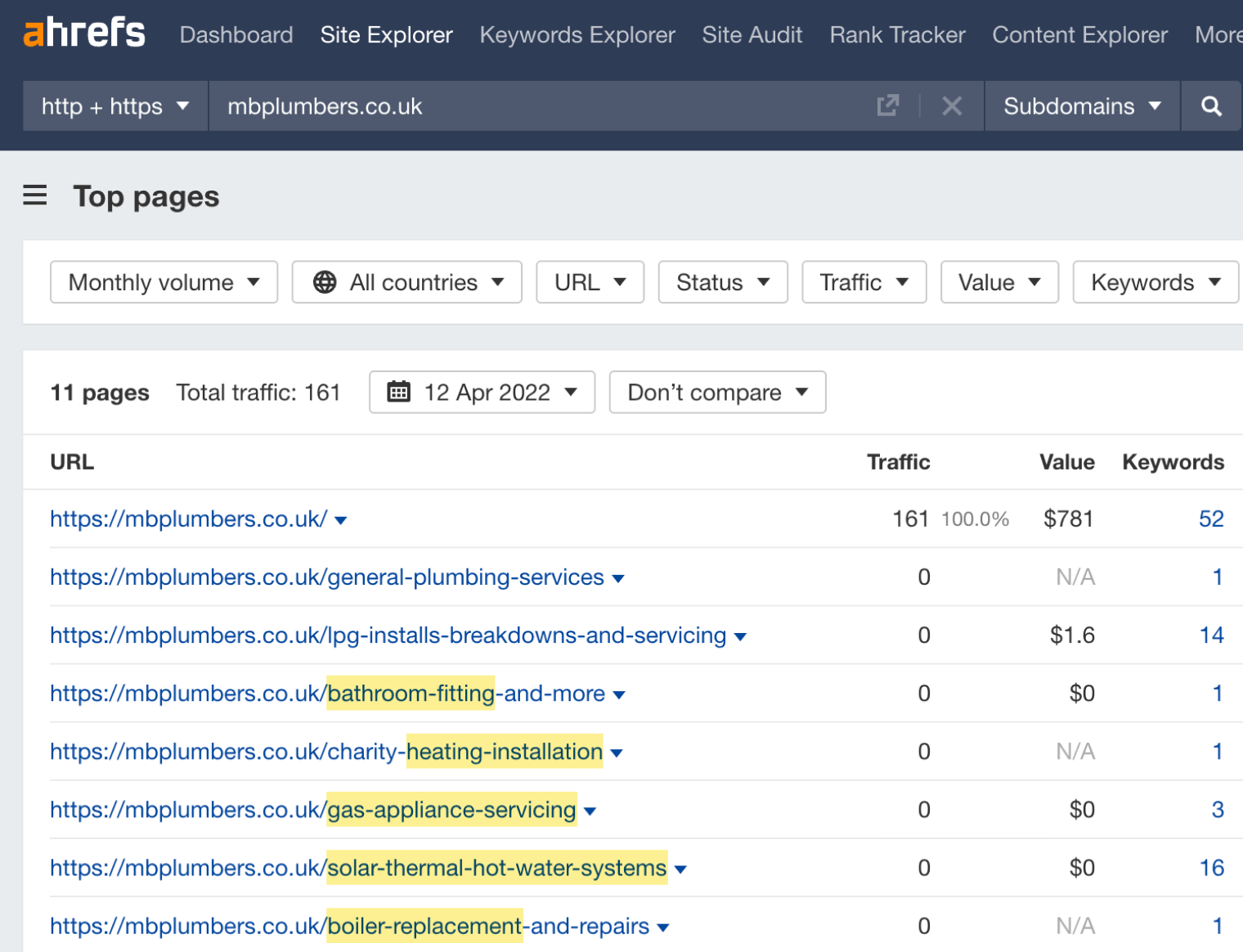
Site Explorer can help you investigate the organic search performance and backlink profiles of competing businesses. Enter a competitor’s website to see which pages attract search traffic and which topics appear to be important to their strategy.

Use this research to spot opportunities, not to copy another business. You might discover that competitors have useful guides, detailed service pages or local case studies that your own website is missing. You can also review their referring websites to identify relevant local publications, trade organisations or community sites that may be worth contacting.

Remember that a competitor’s website data is an estimate, not a complete record of its performance. Treat it as a source of ideas and compare it with what you see in the search results and in your own analytics.

Check your website with Site Audit

A technically sound website makes it easier for search engines and visitors to access your content. Ahrefs’ Site Audit can crawl your site and flag issues that may need attention, such as broken links, redirect problems, missing page titles or slow-loading pages.

For local businesses, check that:

  • your key service and location pages can be crawled and indexed;
  • each important page has a clear, descriptive title and heading;
  • your contact details are easy to find and consistent;
  • the website works well on mobile devices;
  • internal links connect relevant services, locations and supporting information.

Site Audit findings should be prioritised by their likely impact. Fixing every warning is not necessarily the best use of time; focus first on problems affecting important pages or preventing visitors from completing an action.

Build relevant local links

Links from reputable websites can help search engines understand your business and may introduce you to potential customers. Ahrefs’ Site Explorer and Content Explorer can help you find websites, articles and organisations connected to your industry or area.

Consider opportunities such as local business associations, professional bodies, community groups, event organisers, suppliers and local news sites. A useful contribution, partnership or piece of expert information is generally a stronger reason for a link than a mass outreach email asking for one.

Focus on relevance and quality. A link from a trusted local organisation can be more meaningful than many links from unrelated websites. Avoid buying links or joining schemes designed solely to manipulate rankings.

Track progress over time

Ahrefs’ Rank Tracker can help you monitor selected keywords and review how rankings change. Where available, set the target location to match the market you serve. Search results can vary by location, device and personalisation, so a single ranking should not be treated as the whole picture.

Track a balanced set of terms, including your main services, location-specific phrases and useful informational searches. Review trends over time and compare them with more important business measures, such as enquiries, calls, bookings and sales.

What Ahrefs doesn’t replace

Local SEO depends on more than website rankings. Ahrefs does not replace the work of maintaining your Google Business Profile, responding to reviews or checking your business details across relevant directories. Make sure your name, address and phone number are accurate wherever they appear, and keep your opening hours and service information up to date.

Reviews also matter to potential customers. Encourage genuine feedback from customers in line with Google’s policies, and respond professionally to both positive and negative reviews. Never offer incentives in exchange for reviews or post fake feedback.

A simple local SEO workflow using Ahrefs

  1. Define your service area: list the towns, boroughs or neighbourhoods you genuinely serve.
  2. Research search terms: use Keywords Explorer to find relevant local and service-based queries.
  3. Review your website: run a Site Audit and improve important pages, usability and internal links.
  4. Study competitors: use Site Explorer to identify content gaps and relevant link opportunities.
  5. Strengthen local signals: maintain your Google Business Profile, business details and customer reviews.
  6. Measure results: monitor rankings alongside website visits, calls, enquiries and conversions.

Conclusion

Ahrefs can make local SEO more focused by helping you research keywords, assess competitors, identify website issues and explore link opportunities. The strongest results come when those insights are combined with useful local pages, accurate business listings and a positive customer experience.

Use Ahrefs as part of a broader local SEO process, rather than expecting any single tool to deliver rankings on its own. Start with the searches your customers use, make your website genuinely helpful and measure success by the enquiries and customers your visibility brings in.


Top 6 FAQs About Using Ahrefs for Local SEO

  1. Can I use Ahref for free?
  2. Is Ahrefs a SEO tool?
  3. How is local SEO different from SEO?
  4. Is local SEO paid?
  5. How can I do local SEO?
  6. How do I use Ahrefs for local SEO?

Can I use Ahref for free?

Yes, you can use some Ahrefs tools for free. Ahrefs offers a selection of free SEO tools, and Ahrefs Webmaster Tools provides limited access to site audits and backlink data for websites you own and verify. These can help with local SEO basics, but features such as more extensive keyword research and rank tracking may require a paid plan.

Is Ahrefs a SEO tool?

Yes, Ahrefs is an SEO toolset that helps businesses research keywords, analyse competitors’ websites and backlinks, audit technical issues and track search rankings. It can support local SEO by uncovering location-specific search terms and opportunities, but it does not replace managing your Google Business Profile, reviews or local business listings.

How is local SEO different from SEO?

SEO aims to improve a website’s visibility in search results more broadly, while local SEO focuses on reaching people searching for businesses, products or services in a specific area. It places greater emphasis on location-based searches, Google Business Profile, local listings, customer reviews and locally relevant pages. Tools such as Ahrefs can help with keyword research, competitor analysis and website checks for both, but local SEO also depends on accurate business details and strong local signals.

Is local SEO paid?

Local SEO isn’t paid advertising: it focuses on improving your visibility in organic search results and Google Maps. Creating a Google Business Profile is free, although you may choose to pay for SEO tools such as Ahrefs or hire a specialist to help with research, content and optimisation. You can also run paid search ads, but these are separate from local SEO and stop appearing when your advertising budget runs out.

How can I do local SEO?

To do local SEO, make sure your website clearly explains what your business offers and where you serve, with useful service and location pages rather than repetitive pages for every area. Keep your Google Business Profile accurate and up to date, maintain consistent business details across relevant directories, and encourage genuine customer reviews. Use Ahrefs to research local search terms, check your website for technical issues, review competitors and find relevant local link opportunities. Track rankings alongside calls, enquiries and sales so you can see whether your work is attracting the right customers.

How do I use Ahrefs for local SEO?

Use Ahrefs to research location-specific keywords in Keywords Explorer, analyse local competitors’ pages and backlinks in Site Explorer, and run Site Audit to find technical issues on your website. You can also use Rank Tracker to monitor important local search terms and discover relevant local websites that may offer link opportunities. Pair these insights with an up-to-date Google Business Profile, accurate business details and useful pages for the areas you serve.

seo local search

SEO Local Search: A Practical Guide to Reaching Nearby Customers

SEO for Local Search: A Practical Guide for UK Businesses

When people need a nearby service, they often turn to a search engine. They might look for a plumber in Leeds, a café near King’s Cross or an accountant in Bristol. Local search engine optimisation (local SEO) helps businesses appear in these searches and makes it easier for nearby customers to find and contact them.

Whether you run a shop, provide services at customers’ homes or welcome clients to an office, a considered local SEO strategy can improve your visibility in search results, maps and local directories.

What is local SEO?

Local SEO is the process of improving a business’s online presence so it is more visible to people searching for products or services in a particular area. Search engines use signals such as the searcher’s location, the relevance of a business’s website and the quality of its online information to decide which results to show.

Local results may include a map and a selection of nearby businesses, as well as standard website listings. The exact results vary according to the search and the person making it.

Why does local search matter?

Local searches often reflect a clear need. Someone searching for “emergency electrician in Cardiff”, for example, is likely to be looking for a nearby provider rather than general information about electrical work.

Appearing prominently for relevant local searches can help your business:

  • Reach people looking for your services in the areas you cover
  • Generate more calls, enquiries, bookings and visits
  • Build trust through accurate business information and customer reviews
  • Compete with larger companies by focusing on your local market

Create and maintain your business profile

A well-maintained business profile on Google is an important part of local SEO for many businesses. Add your correct business name, address or service area, telephone number, website, opening hours and relevant categories. Choose categories that describe what your business does, rather than adding unrelated terms in the hope of attracting more searches.

Keep the information up to date, particularly if your opening hours change or you move premises. Add useful photographs and respond courteously to questions and reviews. Businesses serving customers at their location should check that their address and service-area settings accurately reflect how they operate.

Keep your business details consistent

Your business name, address and telephone number should be accurate wherever they appear online. These details are often referred to as NAP information: name, address and phone number. Inconsistencies between your website, business profiles and directories can confuse potential customers and make it harder for search engines to confirm which information is correct.

Check important listings regularly and update old details when your business changes address, telephone number or trading name. Consistency matters more than having your details listed on a large number of low-quality directories.

Optimise your website for local relevance

Your website should make it clear what you offer and where you offer it. Include relevant location information in natural, useful places, such as service pages, contact details and page titles. Avoid repeating town names unnaturally or creating large numbers of near-identical pages for different locations.

If you serve several areas, create a dedicated page for each location only where you can provide genuinely helpful information. Explain which services are available there, how customers can access them and any details specific to that area. For a business with one main location, a clear contact page with an address, directions and opening hours may be more useful than multiple thin location pages.

Make your website easy to use on mobile

Many local searches happen on mobile phones, often when someone is out and about. Make sure your website loads promptly, displays correctly on smaller screens and makes key details easy to find. Visitors should be able to tap your phone number, check your opening hours or request directions without unnecessary effort.

Clear navigation, readable text and accessible forms help both potential customers and search engines understand your website.

Encourage and respond to reviews

Reviews can influence a customer’s decision and contribute to the credibility of your business. Ask satisfied customers to share honest feedback, making it easy for them to do so without offering incentives that breach a platform’s rules.

Respond to reviews in a professional and thoughtful way. Thank customers for positive comments, and address criticism calmly. Never post fake reviews or ask others to do so: this can damage trust and may breach review-platform policies.

Create useful local content

Local content can demonstrate your knowledge of the community and answer questions your customers are likely to have. Depending on your business, this could include practical guides, information about local projects, advice on seasonal issues or details about the areas you serve.

Focus on content that is genuinely useful rather than publishing pages simply to include place names. Quality and relevance are more valuable than producing a high volume of repetitive articles.

Measure results and keep improving

Local SEO takes time, so monitor progress rather than relying on a single ranking check. Useful measures may include website visits from local searches, calls, direction requests, enquiries, bookings and the number of relevant search terms bringing people to your site.

Tools such as Google Search Console and website analytics can help you understand how people find and use your website. Business profile insights may also provide information about how customers discover your listing and what actions they take.

Common local SEO mistakes to avoid

  • Using inaccurate or outdated contact details
  • Choosing irrelevant categories or adding keywords to a business name where they do not belong
  • Creating repetitive location pages with little useful information
  • Ignoring reviews or responding defensively
  • Expecting immediate results from local SEO
  • Focusing only on rankings instead of calls, enquiries and other business outcomes

Build a stronger local presence

Effective local SEO brings together accurate business information, a helpful website, positive customer experiences and content that reflects the areas you serve. Start with the basics, keep your details consistent and improve your online presence over time. By focusing on genuine customer needs, your business can become easier to find—and easier to choose—in local search.


Local SEO and Local Search: 7 Frequently Asked Questions

  1. Which is better local SEO or paid search?
  2. How much should I pay for local SEO?
  3. Can I do local SEO myself?
  4. How can we do local SEO?
  5. What is a localized search?
  6. What is SEO Locallist?
  7. What is the difference between SEO and local SEO?

Neither local SEO nor paid search is universally better; the right choice depends on your goals, budget and timescale. Local SEO can build sustainable visibility in local search results over time, while paid search can generate quicker exposure and targeted traffic for specific services, locations or promotions, but usually stops delivering when you pause your spend. For many businesses, using both is effective: paid search can support immediate demand while local SEO strengthens your long-term presence.

How much should I pay for local SEO?

The cost of local SEO depends on your location, competition and the work required. As a rough guide, UK businesses might pay around £300–£800 per month for a freelancer or smaller provider, while agency packages can range from about £500 to £2,000 or more; a one-off audit or set-up may cost several hundred pounds. Ask what’s included—such as Google Business Profile management, website improvements, local content and reporting—and choose a provider who sets clear goals rather than promising guaranteed rankings.

Can I do local SEO myself?

Yes, you can manage many aspects of local SEO yourself. Start by keeping your Google Business Profile and online contact details accurate, improving your website’s location and service pages, asking customers for honest reviews and responding to them professionally. Check your progress using tools such as Google Search Console and your website analytics. More complex technical issues or competition in a crowded market may require specialist support, but consistent attention to the basics can make a real difference.

How can we do local SEO?

To improve your local SEO, start by creating and updating your Google Business Profile with accurate contact details, opening hours, service areas and relevant categories. Make sure your name, address and phone number are consistent across your website and trusted online directories. Add useful location-specific information to your website, ensure it works well on mobile, and encourage customers to leave honest reviews. Regularly check your local search performance and update your details and content as your business changes.

A localized search is a search query where the results are tailored to the searcher’s location or to a place they mention. For example, searching for “coffee shops near me” may show nearby cafés, while “plumbers in Manchester” is focused on a specific area. Search engines use location information and the wording of the query to provide relevant local businesses, services and information.

What is SEO Locallist?

“SEO Locallist” is not a widely recognised standard SEO term. It may refer to a local business listing: an online profile in a directory or platform that shows details such as a business’s name, address, phone number, website and opening hours. Accurate, consistent listings can help customers find a business and support its local search visibility. Check that the information is current wherever the business appears online.

What is the difference between SEO and local SEO?

SEO aims to improve a website’s visibility in search results more broadly, often across national or international markets. Local SEO focuses specifically on helping a business appear in searches connected to a particular place, such as “dentist in Manchester” or “café near me”. It uses location-relevant information—including an accurate business profile, consistent contact details, local reviews and useful location pages—to reach nearby customers. In short, SEO can target a wide audience, while local SEO helps connect a business with people in the areas it serves.

local seo specialists

How Local SEO Specialists Help Businesses Get Found Nearby

Local SEO Specialists: Helping Your Business Get Found Nearby

When people need a nearby service, they often turn to a search engine. They might look for a café, solicitor, plumber or dentist and choose from the businesses that appear in local results. Local SEO specialists help businesses improve their visibility in these searches, so they can reach more potential customers in the areas they serve.

Local search engine optimisation is about more than adding a town name to a webpage. It combines accurate business information, useful local content, a well-optimised website and a strong online reputation. A specialist can bring these elements together in a practical strategy tailored to your business.

What does a local SEO specialist do?

A local SEO specialist works to improve how prominently a business appears in relevant searches with local intent. This may include searches that mention a location, such as “accountant in Bristol”, as well as searches where the search engine understands that the person is looking for a nearby option.

Depending on your needs, their work may include:

  • Google Business Profile optimisation: Reviewing your profile, choosing suitable categories, adding accurate details and helping you make the most of its features.
  • Local keyword research: Finding the phrases potential customers use when searching for your products or services in your area.
  • Website optimisation: Improving service pages, location pages, page titles, headings and internal links.
  • Local citations: Checking that your business name, address and phone number are accurate and consistent across relevant directories.
  • Review guidance: Helping you build a considered approach to requesting and responding to genuine customer reviews.
  • Local content: Planning useful content that reflects your services, local knowledge and customers’ needs.
  • Technical SEO: Identifying issues that could affect how search engines crawl, understand or display your website.
  • Reporting: Tracking agreed measures, such as local visibility, website visits, enquiries and calls.

Why local SEO matters

Local SEO can help connect your business with people who are actively looking for what you offer. Strong local visibility may increase the chances of customers finding your website, calling your business, requesting directions or making an enquiry.

It can also help smaller businesses compete more effectively. A well-maintained local presence gives search engines and customers clearer information about what you do, where you operate and why your business may be relevant.

Results depend on many factors, including competition, location, your website and the quality of your existing online presence. Local SEO is an ongoing process rather than a one-off fix, and no reputable specialist can guarantee a particular ranking.

What to look for when choosing a specialist

The right local SEO specialist should take time to understand your business, customers, service area and goals before recommending a plan. Look for someone who can explain their work in clear language and connect SEO activity to outcomes that matter to your business.

  • A tailored strategy: Your plan should reflect your market and objectives, rather than relying on a generic checklist.
  • Clear communication: You should understand what work is being done, why it matters and how progress will be reviewed.
  • Realistic expectations: Be wary of guaranteed rankings or claims of instant results.
  • Ethical methods: Avoid tactics that rely on fake reviews, misleading business details or unnatural link schemes.
  • Relevant experience: Ask about work with businesses of a similar type or in comparable local markets.
  • Useful reporting: Reports should explain performance and next steps, not simply present a collection of figures.

How a local SEO campaign usually works

Review your current visibility

A specialist will typically assess your website, business listings, Google Business Profile, local competitors and existing search performance. This helps identify opportunities and any issues that need attention first.

Set priorities

Based on the review, they can recommend a sequence of improvements. Priorities might include correcting business details, improving key service pages or strengthening your review process.

Make and monitor improvements

SEO work is implemented and monitored over time. Search visibility and customer behaviour can change, so regular reviews help determine what is working and where the strategy should adapt.

Is local SEO right for your business?

Local SEO is particularly relevant if you serve customers in a defined area, have a physical premises or travel to customers within specific locations. It can benefit independent businesses, multi-location organisations and professional service providers alike.

If your customers can find you through local searches, working with local SEO specialists may help you build a clearer, more consistent presence online. Start by defining what you want to achieve, whether that is more calls, more visits to your premises or more qualified enquiries. From there, you can assess whether a specialist’s approach is a good fit for your business.


8 Essential Tips for Choosing a Local SEO Specialist in the UK

  1. Choose a specialist with proven local SEO results.
  2. Check reviews and case studies from UK businesses.
  3. Ask how they improve Google Business Profiles.
  4. Make sure they target relevant local keywords.
  5. Confirm they build accurate local citations.
  6. Ask how they handle reviews and reputation.
  7. Avoid anyone promising instant rankings.
  8. Agree on clear goals and regular reporting.

Choose a specialist with proven local SEO results.

Choose a local SEO specialist with a track record of delivering results for businesses like yours. Ask for relevant case studies or examples, and look beyond ranking improvements to outcomes such as increased local enquiries, calls or website visits. A credible specialist will explain what they did, how success was measured and what results you can realistically expect—without promising guaranteed rankings.

Check reviews and case studies from UK businesses.

Before choosing a local SEO specialist, check reviews and case studies from UK businesses, particularly those in a similar industry or area. Look for specific examples of the work carried out and the results achieved, rather than vague claims or guaranteed rankings. Independent reviews can also give you a sense of how clearly the specialist communicates, reports progress and responds to challenges.

Ask how they improve Google Business Profiles.

Ask local SEO specialists how they improve Google Business Profiles and what work they’ll carry out. A good specialist should explain how they check your business details, choose relevant categories, add accurate services and keep information up to date. They may also advise on photos, posts and responding to customer reviews. Look for clear, practical recommendations tailored to your business, rather than promises of guaranteed rankings.

Make sure they target relevant local keywords.

A good local SEO specialist will research the terms your potential customers actually use, including relevant services and locations. Rather than targeting broad or popular phrases simply because they attract search volume, they should focus on keywords that reflect your offerings, service areas and customers’ intentions. This helps attract people who are more likely to need your business and makes your website content more useful and relevant.

Confirm they build accurate local citations.

Confirm that your local SEO specialist builds and maintains accurate local citations—mentions of your business name, address and phone number on relevant directories and websites. Consistent details help customers find and contact you, while reducing confusion for search engines. Ask how they check existing listings, correct errors and monitor important citations over time.

Ask how they handle reviews and reputation.

Ask local SEO specialists how they help businesses manage reviews and build a trustworthy online reputation. A good specialist should recommend ethical ways to encourage genuine customer feedback, explain how to respond professionally to positive and negative reviews, and monitor relevant review platforms. Be cautious of anyone offering fake reviews or promising to remove legitimate negative feedback, as these practices can damage trust and put your business at risk.

Avoid anyone promising instant rankings.

Avoid local SEO specialists who promise instant rankings. Search visibility takes time to build, and results depend on factors such as competition, your website and your online reputation. A trustworthy specialist will set realistic expectations, explain the work involved and report on progress without guaranteeing a particular position in search results.

Agree on clear goals and regular reporting.

Agree on clear goals and regular reporting before work begins. Decide what success means for your business, whether that’s more phone calls, enquiries, bookings or visits to your premises, and ask your local SEO specialist how progress will be measured. Regular reports should explain the results in plain English, highlight what’s working and set out the next steps, so you can see how the campaign is contributing to your goals.

best local seo companies

Best Local SEO Companies: How to Choose the Right Partner

Best Local SEO Companies: How to Choose the Right Partner

For a business serving a particular town, city or region, appearing in local search results can make a real difference. A strong local SEO strategy can help potential customers find your business on Google Search and Maps, understand what you offer and get in touch.

The best local SEO company for your business will depend on your location, budget, goals and the support you need. Some providers are full-service digital agencies, while others specialise in local search or offer tools to help you manage the work yourself. The companies below are a useful starting point—not a definitive ranking or guarantee of results.

Local SEO companies to consider

LocaliQ UK

LocaliQ UK offers digital marketing services for businesses, including services intended to help improve local visibility. It may suit organisations looking for support across several areas of digital marketing rather than SEO alone. Ask how its local SEO work is tailored to your locations and how results are reported.

The SEO Works

The SEO Works is a UK digital marketing agency offering SEO and related services. It may be worth considering if you want an agency partner that can look at organic search as part of a wider online growth strategy. Discuss your service areas, competition and expectations before agreeing a campaign.

Hallam

Hallam is a UK digital agency with search marketing expertise. Businesses considering a broader strategy—including SEO and other digital channels—may find its approach relevant. Ask whether the proposed team has experience with businesses like yours and with the locations you want to target.

Blue Array

Blue Array is a UK SEO consultancy that works with organisations on search strategy. It may be suitable for businesses seeking strategic advice or specialist SEO support. If local visibility is your priority, check that the proposal specifically covers local rankings, Google Business Profile and location-specific pages.

Whitespark

Whitespark is a Canada-based local SEO provider known for local search tools and services. Its resources may be useful to businesses looking to manage parts of local SEO themselves, as well as those seeking specialist support. UK businesses should confirm that the service and advice fit their market and locations.

Sterling Sky

Sterling Sky is a Canada-based agency focused on local SEO. It may be of interest to businesses looking for specialist local search expertise. As with any provider based overseas, check its experience in your country, how communication and reporting will work, and whether its recommendations reflect local search practices.

What does a local SEO company do?

Local SEO focuses on helping a business appear in search results for relevant services and places. Depending on the provider and your needs, work may include:

  • Reviewing and improving your Google Business Profile
  • Checking that your business name, address and phone number are consistent online
  • Researching local search terms and competitors
  • Improving location and service pages on your website
  • Supporting a genuine customer review strategy
  • Finding relevant local directories and citation opportunities
  • Monitoring local visibility, website enquiries and other agreed outcomes

Not every business needs every service. A single-location tradesperson, for example, may need different support from a multi-location healthcare group or a chain of shops.

How to choose the best local SEO company

Look for relevant experience

Ask for examples of work with businesses in your sector and in markets similar to yours. Case studies should explain the work carried out and the results measured, rather than relying only on broad claims about rankings.

Understand the proposed strategy

A reputable provider should explain what it plans to do, why those activities matter and how they relate to your goals. Be cautious of vague packages that promise a set number of links or rankings without first reviewing your website and competition.

Ask how success is measured

Rankings can be useful, but they are only one part of the picture. Ask how the company will track relevant calls, enquiries, bookings or visits, and how it will distinguish meaningful leads from general website traffic.

Check who will do the work

Find out who your main contact will be, who carries out the work and how often you will receive updates. If several locations are involved, ask how the provider will manage the workload and maintain consistency.

Clarify costs and ownership

Request a clear breakdown of fees, services and contract terms. Make sure your business retains access to its website, analytics accounts and Google Business Profile, and ask what happens to any work or content if the agreement ends.

Warning signs to watch for

  • Guaranteed first-place rankings or instant results
  • Unclear descriptions of the work being delivered
  • Pressure to sign a long contract before an audit or discussion
  • Recommendations to create misleading listings or reviews
  • Reports that show activity but do not connect it to business outcomes

Final thoughts

The best local SEO company is one that understands your customers and service area, explains its work clearly and measures progress against outcomes that matter to your business. Compare several providers, ask specific questions and choose a partner whose approach is realistic, transparent and suited to your goals.


Essential FAQs for Choosing the Best Local SEO Companies in the UK

  1. What are the best local SEO companies in the UK?
  2. How do I choose the right local SEO company for my business?
  3. How much do local SEO companies charge in the UK?
  4. What services should a local SEO company provide?
  5. How long does it take for a local SEO company to deliver results?

What are the best local SEO companies in the UK?

The best local SEO companies in the UK depend on your business, budget and service area, so there is no single provider that suits everyone. When comparing agencies, look for proven experience with businesses like yours, a clear plan for improving local search visibility, transparent reporting and realistic expectations. Ask how they’ll support your Google Business Profile, local website pages and customer reviews, and check that you’ll retain access to your accounts. Compare proposals and case studies before choosing a partner.

How do I choose the right local SEO company for my business?

Choose a local SEO company that understands your industry, customers and service area, and can explain clearly how its strategy will support your goals. Ask for relevant case studies, details of the work included, and how it measures outcomes such as calls, enquiries or bookings—not just rankings. Check the costs, contract terms and reporting arrangements, and make sure you retain access to your website and business listings. Be wary of guaranteed rankings or promises of instant results; a trustworthy provider will set realistic expectations and tailor its recommendations to your business.

How much do local SEO companies charge in the UK?

Local SEO costs in the UK vary depending on your location, competition, number of branches and the work required. Smaller businesses may pay a few hundred pounds a month for ongoing support, while more competitive campaigns or multi-location businesses can cost considerably more; one-off audits and consultancy are often priced separately. Ask for a clear breakdown of the services, reporting and contract terms, and compare proposals by the value and scope of work—not just the monthly fee.

What services should a local SEO company provide?

A local SEO company should provide services that help your business appear in relevant local search results and attract nearby customers. These may include optimising your Google Business Profile, researching local keywords, improving location and service pages, checking that your business details are consistent across online directories, and supporting a genuine customer review strategy. The company should also monitor local visibility and meaningful outcomes, such as calls, enquiries or bookings, and provide clear reports explaining the work completed and its impact. The right services will depend on your business, locations and goals, so expect a tailored plan rather than a one-size-fits-all package.

How long does it take for a local SEO company to deliver results?

A local SEO company can often make initial improvements within a few weeks, but noticeable results typically take several months. The timeframe depends on factors such as your website’s starting point, local competition, the condition of your Google Business Profile and how consistently recommended changes are made. A reputable company should set realistic expectations, explain which early indicators it will track and report on progress towards meaningful outcomes such as enquiries, calls or bookings.

local seo for business

Local SEO for Business: A Practical Guide to Reaching Nearby Customers

Local SEO for Business: How to Get Found by Nearby Customers

When people need a nearby service, they often turn to a search engine. They might look for a plumber in Manchester, a café near a station or a solicitor in their town. Local search engine optimisation (local SEO) helps businesses appear in these searches and makes it easier for potential customers to find, contact and visit them.

Whether you run a shop, a restaurant or a service-area business, local SEO can help you reach people looking for what you offer in a specific location. Here’s how it works and what you can do to improve your local visibility.

What is local SEO?

Local SEO is the process of improving your online presence so your business is more likely to appear in searches with local intent. These searches may include a place name, such as “accountant in Leeds”, or phrases such as “near me”. Search engines can also interpret local intent when someone searches for a service without naming a location.

Local results can appear in the standard search listings, on maps and in dedicated local business features. Where and how your business appears depends on factors such as its relevance to the search, its location and the information available about its prominence.

Why local SEO matters

Local SEO can connect your business with people who are actively looking for nearby products or services. Accurate listings and useful website content also help prospective customers decide whether to contact you or visit.

For smaller businesses, a well-maintained local presence can help them compete for attention in their area. It is not a guarantee of higher rankings or more sales, but it gives search engines and customers clearer information about your business.

Set up and improve your Google Business Profile

A Google Business Profile helps your business appear on Google Search and Maps. Claim or create your profile, then check that the details are complete and accurate.

  • Business name: Use the name customers know you by. Avoid adding extra keywords that are not part of your real business name.
  • Address or service area: Provide the right location details. If you visit customers but do not serve them at your premises, set up the profile to reflect that.
  • Category: Choose the most relevant primary category, and add other suitable categories where available.
  • Contact details: Keep your phone number and website address up to date.
  • Opening hours: Add regular hours and update them for bank holidays or other changes.
  • Services, products and photos: Add helpful information that gives people a clear idea of what you offer.

Review your profile regularly. Out-of-date details can frustrate customers and make it harder for them to take the next step.

Keep your business details consistent

Your business name, address and phone number should be consistent across your website and relevant online directories. Search for old addresses, previous phone numbers or duplicate listings and correct them where possible.

Consistency helps customers avoid confusion and gives search engines more reliable information. Focus on trustworthy directories and industry-specific listings rather than submitting your details to every directory you can find.

Make your website locally relevant

Your website should clearly explain what your business does, where it operates and how customers can get in touch. Include your location naturally in the content where it helps visitors, rather than repeating place names unnaturally.

Useful improvements can include:

  • Creating a clear contact page with your address, phone number and opening hours, where relevant.
  • Adding a map or directions for customers visiting your premises.
  • Explaining the areas you serve if you travel to customers.
  • Creating individual location pages for genuine branches, with useful information specific to each one.
  • Checking that key pages work well on mobile devices and load reliably.

Avoid publishing near-identical pages for lots of towns if they offer no useful information for visitors. Each location page should reflect a real service area or branch and answer questions customers in that location may have.

Build a steady process for customer reviews

Reviews can help people understand what it is like to deal with your business. Invite customers to leave honest feedback after a genuine interaction, and make it easy for them to find the right review platform.

Respond politely to positive and negative reviews. Thank customers for useful feedback, and address concerns without sharing private information. Never buy reviews, offer incentives in ways that break platform rules, or ask only customers you expect to be pleased to leave feedback.

Create helpful local content

Local content can demonstrate your knowledge of the area and answer the questions customers commonly ask. For example, a building firm might explain planning considerations relevant to local homes, while a restaurant could publish seasonal menus or information about nearby events.

Prioritise content that is accurate, useful and connected to your services. A page does not need to mention a location repeatedly to be relevant to local customers.

Earn relevant local links and mentions

Links from reputable local organisations can help people discover your business and provide useful context about your work. Consider genuine opportunities such as joining a recognised trade association, supporting a community event or contributing expertise to a local publication.

The aim is to build real relationships and earn relevant mentions, not to acquire large numbers of low-quality links. Avoid link schemes that promise quick ranking improvements.

Measure what is working

Track both your visibility and the actions that matter to your business. Depending on your setup, useful measures may include:

  • Calls, enquiries, bookings or online purchases.
  • Visits to key pages on your website.
  • Search queries that bring people to your site.
  • Interactions with your business profile, such as website visits or direction requests.
  • Changes in local search visibility for relevant services and locations.

Use analytics and search performance tools to look for patterns over time. Rankings can vary by search, location and device, so avoid judging your progress by one search from one place.

Common local SEO mistakes to avoid

  • Leaving business hours, addresses or phone numbers out of date.
  • Creating duplicate or misleading business listings.
  • Adding location keywords unnaturally to your business name or website copy.
  • Publishing thin location pages with little value for visitors.
  • Ignoring reviews or responding defensively.
  • Expecting immediate results from local SEO work.

Getting started with local SEO

Begin with the essentials: check your business profile, correct your contact details across the web and make sure your website clearly describes your services and locations. Then build a consistent routine for gathering customer feedback, publishing useful content and reviewing performance.

Local SEO is an ongoing process. Search behaviour, competitors and business details change, so regular maintenance matters. By giving customers accurate information and making your website genuinely useful, you can build a stronger local presence and make it easier for nearby customers to choose your business.


Local SEO for Business: Your Top Questions Answered

  1. Is local SEO right for my business?
  2. What is local SEO in business?
  3. How local SEO helps your business?
  4. What kind of businesses need local SEO?
  5. Is doing a local SEO worth it?
  6. Can ChatGPT do SEO?

Is local SEO right for my business?

Local SEO is likely to be useful if your business serves customers in a particular area, has a physical premises or travels to customers nearby. It can help people find your services when they search for businesses in their town or “near me”. It may be less relevant if you operate entirely online and serve customers nationally or internationally, though local SEO could still help if you target specific areas. Consider where your customers are and how they search before deciding which local SEO activities to prioritise.

What is local SEO in business?

Local SEO in business is the process of improving a company’s online presence so it can be found more easily by people searching for nearby products or services. It includes keeping business details accurate across online listings, optimising a Google Business Profile, adding useful location information to the website and encouraging genuine customer reviews. These steps help search engines understand where a business operates and help local customers find, contact or visit it.

How local SEO helps your business?

Local SEO helps your business become more visible to people searching for nearby products or services. By keeping your business details accurate, improving your website for local searches and earning genuine customer reviews, you can make it easier for potential customers to find you, learn what you offer and get in touch. It can also help attract more relevant local enquiries, visits and bookings over time.

What kind of businesses need local SEO?

Local SEO is valuable for any business that serves customers in a specific area or has a physical location. This includes shops, cafés, restaurants, tradespeople, healthcare providers, salons, professional services and businesses that travel to customers, such as plumbers or cleaners. If people nearby are likely to search online for your products or services, local SEO can help them find your business.

Is doing a local SEO worth it?

Yes, local SEO is often worth it for businesses that serve customers in a specific area. It can help your business appear in relevant local searches, making it easier for nearby customers to find your services, visit your premises or get in touch. Results take time and aren’t guaranteed, but keeping your business details accurate, improving your website and managing customer reviews can build visibility over time. Track enquiries, calls and visits to see whether your efforts are delivering value.

Can ChatGPT do SEO?

ChatGPT can support many SEO tasks, such as brainstorming keywords, outlining articles, drafting content, suggesting title tags and explaining technical SEO concepts. However, it cannot guarantee rankings or replace the local knowledge, research and judgement needed to build an effective strategy. AI-generated content should be checked for accuracy, originality and usefulness, particularly when it includes local details, and business information should always be verified. Used as an assistant rather than a substitute for expertise, ChatGPT can help make local SEO work more efficient.